Esther Williams
Esther Williams, the swimming champion turned actress who starred in glittering and aquatic Technicolor musicals of the 1940s and 1950s, has died. She was 91. “Esther Williams had one contribution to make to movies — her magnificent athletic body,” the film critic Pauline Kael wrote. “And for over 10 years MGM made the most of it, keeping her in clinging, wet bathing suits and hoping the audience would shiver.”
When she was in her teens, the Los Angeles Athletic Club offered to train her four hours a day, aiming for the 1940 Olympic Games at Helsinki. In 1939, she won the Women’s Outdoor Nationals title in the 100-meter freestyle, set a record in the 100-meter breaststroke and was a part of several winning relay teams. But the outbreak of war in Europe that year canceled the 1940 Olympics, and Esther dropped out of competition to earn a living.

Esther Williams
She was selling clothes in a Wilshire Boulevard department store when showman Billy Rose tapped her for a bathing beauty job at the World’s Fair in San Francisco.
While there, she was spotted by an MGM producer and an agent. She laughed at the suggestion she do films that would popularize swimming, as Henie had done with ice skating.
“Frankly I didn’t get it,” she recalled. “If they had asked me to do some swimming scenes for a star, that would have made sense to me. But to ask me to act was sheer insanity.”
She finally agreed to visit MGM boss Louis B. Mayer, and recalled that she took the job after her mother told her: “No one can avoid a challenge in life without breeding regret, and regret is the arsenic of life.”
At a time when most movies cost less than $2 million, MGM built the actress a $250,000 swimming pool on Stage 30. It had underwater windows, colored fountains and hydraulic lifts, and it was usually stocked with a dozen bathing beauties. Performing in that 25-foot-deep pool, which the swimmers nicknamed Pneumonia Alley, she ruptured her eardrums seven times.

Esther Williams
By 1952, the swimming sequences in Esther Williams’ movies, which were often elaborate fantasies created by Busby Berkeley, had grown more and more extravagant. For that year’s Million Dollar Mermaid, she wore 50,000 gold sequins and a golden crown. The crown was made of metal, and in a swan dive into the pool from a 50-foot platform, her head snapped back when she hit the water. The impact broke her back, and she spent the next six months in a cast.
The actress once estimated that she had swum 1,250 miles for the cameras. In a bathing suit, she was a special kind of all-American girl: tall, lithe, breathtakingly attractive and unpretentious. She begged MGM for serious nonswimming roles, but the studio’s response was, in effect, “If it ain’t broke, don’t fix it.” Audiences rejected her in dramas like The Hoodlum Saint (1946) and often disregarded film noir, The Unguarded Moment (1956). Her only dry-land box-office success was Take Me Out to the Ball Game (1949), with Esther Williams as the owner of a baseball team whose players included Frank Sinatra and Gene Kelly.
When Elizabeth Taylor passed away, the national news took light at mentioning the last of the Hollywood legends had passed away but we knew better — Mickey Rooney, Jane Withers, Rhonda Fleming and Esther Williams are among the many still around. Sadly, one more has been scratched off the list. Esther Williams’ publicist Harlan Boll says she died peacefully in her sleep early Thursday morning. In honor of her memory, pick up an Esther Williams movie in the stores today or rent a DVD from classicflix.com or Netflix and enjoy a good movie starring the bathing beauty of MGM.

Esther Williams
TRIVIA
Williams in a bathing suit became a favorite pinup of GI’s in World War II, and her popularity continued afterward.
The popular “Andy Hardy” series movies were MGM’s tests for its promising stars such as Judy Garland, Lana Turner and Donna Reed. If you didn’t make it in those pictures, you were never heard from again. This was why Esther Williams made her first motion picture appearance in Andy Hardy’s Private Life (1942). It was in that movie she received her first screen kiss — from Mickey Rooney.
Esther Williams was an advisor to the International Olympic Committee at the 1984 Summer Olympics in Los Angeles for the new sport of Synchronized Swimming.
She lent her name to a brand of swimming pools that are still sold today, Esther Williams Pools.
QUOTES
“All they ever did for me at MGM was change my leading man and the water in my pool.”
Turner Classic Movies Film Festival
Movie schedule TCM
Share this info with friends:

The Blob (1958)
A mysterious creature from another planet, resembling a giant blob of jelly, lands on earth. The people of a nearby small town refuse to listen to some beatnik hot rod teenagers who have witnessed the blob’s destructive power and growth. In the meantime, the blob just keeps on getting bigger…
With an estimated cost of $120,000, The Blob was directed by Irvin Yeaworth, who had directed more than 400 films for motivational, educational, and religious purposes. The Blob was filmed in and around Valley Forge, Pennsylvania. The primary shooting took place at Valley Forge Studios, and several scenes were filmed in the towns of Chester Springs, Downingtown, Phoenixville and Royersford, including the basement of a local restaurant named Chef’s. (The setting is apparently Downingtown Pennsylvania itself as the one policeman identifies his department’s office as “Downingtown HQ to East Cornwall HQ” over the two-way radio during his chess game, and the final scenes take place in a restaurant that is clearly labeled “Downingtown Diner”.)
The movie also introduced American audiences to a new up-and-coming actor named Steven McQueen, who was offered $2,500 or ten percent of the profits. He took the $2,500 believing the cheap production showed no promise and expected the film to be a box office disaster. Clearly a bad business decision because The Blob ended up grossing over $4 million. This wasn’t a total loss, however. Dick Powell, who was the head of Four Star Productions, asked to see a rough cut of the film before it was released theatrically. This led to the casting of Steve McQueen in the television series Wanted: Dead or Alive.

Steve McQueen in THE BLOB (1958).
The movie has become a cultural hit throughout the world. The song “Beware of the Blob,” performed during the opening credits, still airs over Sirius/XM Satellite channels and local radio stations across the country — especially on Halloween. References to The Blob are evident in such classics as Grease (1978, it was the trailer shown at the drive-in), Gremlins (1984), Rebel Without A Cause (1955) and Forbidden Planet (1956) — the latter film, if you watch real carefully, a part of the movie poster can be seen on camera!
The film was originally titled The Molten Meteor until producers overheard screenwriter Kay Linaker refer to the movie’s monster as “the blob.” Other sources give a different account, saying that the film went through a number of title changes (even the monster was called “the mass” in the shooting script) before the makers settled on The Glob, then hearing that cartoonist Walt Kelly had used The Glob as a title for his children’s book, and mistakenly believing that they could no longer use it as a title, they changed it to The Blob.

The Blob attacks the movie theater.
According to producer Jack H. Harris in Interviews with B Science Fiction and Horror Movie Makes by Tom Weaver, “Vegetable coloring gave The Blob the red color; it got redder and redder as it grew and consumed more people. One thing we never resolved was, how do you keep the color in there? We just had to keep mixing it, like cake batter, otherwise it would all settle to the bottom. The most we worked with was about a washtub full. Naturally we couldn’t afford to cover a diner with the Blob, so what we did there was photograph the diner through a bent bellows to give it dimension. To correct any minute flaws we enhanced the photograph with touch-up and air-brushing. We then mounted it on plywood, set it up on an eight-foot-square gyroscope-operated table and tied cameras to the table, rock-steady. Then we were able to move the table in any direction we wanted; the Blob, of course, would always follow gravity. When we wanted the Blob to jump on the “diner,” we put it there and got it to jump off with a quick movement of the table. That footage, shown in reverse, gave us our effect.”
The Blob was created with a modified weather balloon in the early shots, and in the later shots with colored silicone gel. The actual Blob, a mixture of red dye and silicone, is still kept in the original five-gallon pail in which it was shipped to the production company in 1958 from Union Carbide. Over the years as a part of the annual Blobfest, held over a three-day period each summer in Phoenixville, PA, which provided a number of the shooting locales for the film, the original Blob has been put on display for fans to admire and have their picture taken. Also on display are miniatures used in the shooting.

The Best Blob Book!
Wes Shank, author of From Silicone to the Silver Screen: Memoirs of The Blob (1958), presently owns the original creature. “My connection to the 1958 movie The Blob is that I’m referred to as ‘the caretaker of the blob silicone.’ Beginning in 1960 I collected movie posters and publicity photos. The blob silicone was the first prop in my collection which was purchased from the director, Shorty Yeaworth, in 1965,” Shank explains.
“Since acquiring the silicone I have shared with the public my love of The Blob (1958) through lectures and exhibitions. The blob silicone is always the center attraction. Over the years I have lectured and exhibited the blob silicone throughout the Philadelphia area such as the Philadelphia Museum of Art, the Villanova University cultural film series, the Moore College of Art, and the Franklin Institute. In addition I have also exhibited the blob silicone at various sci-fi conventions as Fanex, Chiller, and Monster Bash. Yearly the blob silicone is the center of attention at Blobfest in Phoenixville PA.”
Wes Shank’s book is highly recommended. You can buy your copy by clicking here to visit his web-site.
http://www.theblobbook.com/index.htm

The Blob silicone on display in 2013!
Wes will also be attending the 2013 Mid-Atlantic Nostalgia Convention and The Blob silicone, along with other props and memorabilia from the movie, will be on display.
That’s right, you can have your photo taken with The Blob silicone!
Wes will also have copies of his book for sale (make sure you get him to autograph your copy!) along with other Blob merchandise.
We’ll also be screening the movie on Friday night at our drive-in with a couple bonus film shorts including Abbott and Costello Meet The Blob!
Share this info with friends:

Chuck Connors and Johnny Crawford
If you don’t recall Johnny Crawford as one of Walt Disney’s original Mouseketeers in 1955, you certainly remember him in the role of Mark McCain, Chuck Connors’ sensitive young son on television’s The Rifleman. Connors became an acting mentor for Crawford, who later recalled: “He was my hero. I enjoyed being with him. He wasn’t as stern as he was on camera. He was like a kid around me.”
Disney started out with twenty-four original Mouseketeers. At the end of the first season, the studio reduced the number to 12 and Johnny was released from his contract. His first important break as an actor followed with the title role in a Lux Video Theatre production of “Little Boy Lost,” a live NBC broadcast on March 15, 1956. Following that performance, the young actor worked steadily with many seasoned actors and directors. Freelancing for two-and-a-half years, he accumulated almost 60 television credits, including featured roles in three episodes of NBC’s The Loretta Young Show. By the spring of 1958, Crawford made three pilots for a series. The third pilot, “The Sharpshooter,” which was made as an episode of Zane Grey Theater and scripted by the legendary Sam Peckinpah, was picked up by ABC and the first season of The Rifleman began filming in July 1958. (Oddly, the script was originally written and submitted to the producers of Gunsmoke, promptly rejected.)

Johnny Crawford from THE RIFLEMAN
Crawford was nominated for an Emmy Award at the age of 13 for his role as Mark McCain, the son of Lucas McCain (played by Chuck Connors) in The Rifleman, which originally aired from 1958 to 1963. During this time, Crawford had wide popularity with American teenagers and a recording career that generated five Top 40 hits, including the single, “Cindy’s Birthday,” which peaked at #8 on Billboard’s Top 40 in 1962. His other hits included “Rumors” (#12, 1962), “Your Nose is Gonna Grow” (#14, 1962), and “Proud” (#29, 1963).
Late in 1961, Crawford appeared as Victor in the episode “A Very Bright Boy” of the ABC sitcom, The Donna Reed Show. (We’ll be screening a copy of both the pilot for The Rifleman and this Donna Reed television episode.)

The Mickey Mouse Club
Throughout The Rifleman’s five seasons, there was a remarkable on-screen chemistry between Connors and Crawford in the depiction of their father-son relationship. They were still close friends when Connors died on November 10, 1992, and Crawford gave a eulogy at his memorial.
Among his films, Crawford plays an American Indian in the unique adventure film, Indian Paint (1965). He gets mixed up with a disturbed young girl played by Kim Darby in The Restless Ones (1965), and he gets shot by John Wayne in El Dorado (1966).
According to David Fury’s book, Chuck Connors: The Man Behind the Rifle, when Johnny Crawford came on the set in 1958—he was then a little twelve-year-old boy―he called everyone in the cast or crew, sir or ma’am. During the course of the five years of our run, he had two hit records, and he was nominated for an Emmy for Best Supporting Actor. And yet, when the show was finished after five seasons, Johnny went around and thanked everyone in the cast and crew, and he still called them sir or ma’am.

Chuck Connors and Johnny Crawford
In 1991, Johnny Crawford made a cameo as Mark McCain in the made-for-TV movie, The Gambler Returns: The Luck of the Draw, now portrayed as a grown-up version of Mark McCain.
The Rifleman still remains popular to this day. In 2011, the program was the most widely syndicated TV Western in the United States. Just a few months ago, CBS announced plans to remake the original Rifleman series. Chris Columbus will be the executive producer, and will also direct. The original series was produced by Jules Levy, Arthur Gardner and Arnold Laven. Robert Levy, Steven Gardner, and Arthur Gardner are executive producers of the remake.
With five Top 40 hits in the 1960s, Crawford’s recording of “Cindy’s Birthday” peaked at #8 on Billboard’s Top 40 in 1962. Since 1992, Johnny Crawford has led a California-based vintage dance orchestra which performs at special events. His band has been sponsored by the Playboy Jazz Festival, and has been the repeated choice for fifteen annual Art Directors Guild Awards at the Beverly Hilton. A remastered version of the orchestra’s highly rated first album, Sweepin’ the Clouds Away, was officially released on September 30, 2011.

Johnny Crawford Dance Orchestra
This September, Johnny Crawford will be among the weekend guests at the Mid-Atlantic Nostalgia Convention. Make sure to bring your rifles and brush up on your knowledge of The Rifleman!
Selected Television and Movie Appearances
The Gambler Returns: The Luck of the Draw (1994)
Guns of Paradise, “Crossfire” (1990)
Guns of Paradise, “A Gathering of Guns” (1989)
Crossbow (as Crown Prince Ignatius from 1987 to 1988)
Murder, She Wrote, “A Lady in the Lake” (1985)
Little House on the Prairie, “The Hunters” (1976)
Cade’s County, “Requiem for Miss Madrid” (1971)
The Resurrection of Broncho Billy (1970)
The Big Valley, “The Other Face of Justice” (1969)
Hawaii Five-O, “By the Numbers” (1968)
Lancer, “The Prodigal” (1968)
Rawhide, “Crossing at White Feather” (1965)
The Restless Ones (1965)
Village of the Giants (1965)
Mister Ed, “Ed a Go-Go” (1965)
Indian Paint (1965)
Mr. Novak, “Let’s Dig a Little Grammar” (1964)
Branded, “Coward Step Aside” (1965)
The Rifleman (played Mark McCain from 1958 to 1963)
The Donna Reed Show, “A Very Bright Boy” (1961)
Tales of Wells Fargo, “The Dealer” (1958)
The Space Children (1958)
The Restless Gun, “Gratitude” (1958)
Matinee Theater, “The Iceman” (1958)
Matinee Theater, “Some Blessed People” (1958)
Trackdown, “The Deal” (1958)
Playhouse 90, “The Dungeon” (1958)
Wagon Train, “The Sally Potter Story” (1958)
Adventures of Wild Bill Hickok, “Spurs for Johnny” (1958)
Whirlybirds, “Panic at Green Ridge” (1957)
Whirlybirds, “Ghost Town Flight” (1957)
Make Room For Daddy, “Wyatt Earp Visits the Williamses” (1956)
Have Gun – Will Travel, “The Hanging Cross” (1957)
Mr. Adams and Eve, “The Producers” (1957)
The Frank Sinatra Show, “That Hogan Man” (1957)
The Millionaire, “The Frank Keegan Story” (1957)
The Sheriff of Cochise, “I Am an America” (1957)
The O.Henry Playhouse, “Hearts and Hands” (1957)
The Lone Ranger, “The Cross of Santo Domingo” (1956)
The Cavalcade of America, “The Boy Nobody Wanted” (1956)
The Man in the Gray Flannel Suit (1956)
Share this info with friends:

Mamie Van Doren
When 20th Century Fox scored a hit with Marilyn Monroe, every movie producer wanted to cash in with their own platinum blonde. Diana Dors… Jayne Mansfield… and Mamie Van Doren come to mind. The latter of whom posed twice for Playboy in 1963 to promote her movie, 3 Nuts in Search of a Bolt (1964), though she was never officially a Playmate. Mamie Van Doren, a talented actress who proved she had more sex appeal than her competition, even has a star on the Hollywood Walk of Fame. Looking back on an era of beatniks, rock ‘n’ roll and Beatles haircuts, Mamie Van Doren set the standard for pop icons of the 20th Century. Some credit the actress for helping bring the rock ‘n’ roll-style of music alive in the B-musical Untamed Youth (1957), now available commercially through Warner Archive DVD. But few can deny her sex appeal. After all, when a film like The Beat Generation (1959) or High School Confidential (1958) is screened on Turner Classic Movies, film buffs do not refer to those flicks as “a dated property” or a “juvenile delinquent picture”… they often refer to such gems as “a Mamie Van Doren” movie. That’s star credit that ranks next to the great Bette Davis, Joan Crawford and Maryl Streep.
Mamie Van Doren was born Joan Lucille Olander in Rowena, South Dakota, three-quarters Swedish ancestry; the remainder is mixed English and German. Her mother named her after Joan Crawford. In 1939, the family moved to Sioux City, Iowa and during May 1942 they then moved to Los Angeles.

Mamie Van Doren 1953
In early 1946, Van Doren began working as an usher at the Pantages Theatre in Hollywood. The following year, she had a bit part on an early television show. She also sang with Ted Fio Rito’s band and entered beauty contests. In the summer of 1949, at age 18, she won the titles “Miss Eight Ball” and “Miss Palm Springs.” Discovered by producer Howard Hughes on the night she was crowned Miss Palm Springs, the pair dated for several years. Hughes launched her career by placing her in several RKO films: including a bit part in Jet Pilot, which was her film debut. Her line of dialogue consisted of one word, “Look!” and she appears uncredited in the film. (Though production of the movie was from 1949 to 1953 (delays by Hughes), it was not released until 1957)
The following year, 1951, she posed for famous pin-up girl artist Alberto Vargas, the painter of the glamorous “Vargas Girls.” His painting of Van Doren was on the July cover of Esquire. Van Doren did a few more bit parts in movies at RKO, including His Kind of Woman (1951) starring Robert Mitchum, Jane Russell and Vincent Price. About her appearance in that one, Van Doren has said, “If you blinked you would miss me. I look barely old enough to drive.”

Mamie Van Doren
Van Doren then began working on the stage. She was a showgirl in New York in Monte Proser’s nightclub version of Billion Dollar Baby. Songwriter Jimmy McHugh discovered her for his musicals, then decided she was too good for the chorus line and should have dramatic training. She studied with Ben Bard and Bliss-Hayden. While appearing in the role of Marie in a showcase production of Come Back, Little Sheba, Van Doren was seen by Phil Benjamin, a casting director at Universal International.
On January 20, 1953, Van Doren signed a contract with Universal Studios. They had big plans for her, hoping she would bring the same kind of success that 20th Century Fox had with Marilyn Monroe. Van Doren, whose signing day coincided with the inauguration of President Eisenhower, was given the first name Mamie for Ike’s wife, Mamie Eisenhower.
Universal first cast the beauty in a minor role as a singer in Forbidden, starring Tony Curtis. Interested in Van Doren’s allure, Universal then cast her in The All American (1953), also starring Tony Curtis, playing her first major role as Susie Ward, a wayward girl who is the man-trap at a campus beer joint. In Yankee Pasha (1954), starring Jeff Chandler and Rhonda Fleming, she played a slave girl, Lilith, in a supporting role. In 1955, she had a supporting role in the musical Ain’t Misbehavin’ and starred in the crime-drama, Running Wild. Soon thereafter, Van Doren turned down a Broadway role in the play Will Success Spoil Rock Hunter?, and was replaced by newcomer Jayne Mansfield.

Mamie Van Doren
In 1956, Van Doren appeared opposite a young and unknown (at the time) Clint Eastwood in the western, Star in the Dust. Though Van Doren garnered prominent billing alongside John Agar and Richard Boone, she appears rather briefly, as the daughter of a ranch owner. By this time, Van Doren had grown tired of Universal, which was only casting her in non-breakthrough roles. Therefore, Van Doren began accepting bigger and better roles in better movies, from other studios.
Van Doren went to star in several bad girl movies that later became cult films. It was these movies that launched her name on theater marquees. She also appeared in some of the first movies to feature rock ‘n’ roll music and became identified with this rebellious style, and made some rock records. One of her rock ‘n’ roll films, Untamed Youth, is now considered an essential classic for anyone wanting to enjoy such drive-in-style motion pictures of the 1950s.
Some of Van Doren’s more noteworthy movies include Teacher’s Pet (1958) at Paramount Pictures, Born Reckless (1958) at Warner Brothers, High School Confidential (1958), and The Beat Generation (1959), the latter two at Metro-Goldwyn-Mayer. But she was just as well known for her provocative roles. She was in prison for Girls Town (1959), which provoked censors with a shower scene where audiences could see Van Doren’s naked back. As Eve in The Private Lives of Adam and Eve (1960) she wore only fig leaves, and in other films, like The Beautiful Legs of Sabrina (1959), Sex Kittens Go to College (1960) and Vice Raid (1960) audiences were clued in as to the nature of the films from the titles. More amusing was the catch-phrase on the movie poster for Sex Kittens Go to College: “You’ve never seen a student body like this!”

Mamie Van Doren
Many of Van Doren’s film roles showcased her ample curves, and her onscreen wardrobe usually consisted of tight sweaters, low-cut blouses, form-fitting dresses, and daring (for the era) swimsuits, but she and such other blonde bombshell contemporaries as Jayne Mansfield, Cleo Moore, Sheree North, Anita Ekberg, Barbara Lang, Joi Lansing, Greta Thyssen, and Barbara Nichols did not attain the same level of superstar status as Marilyn Monroe. Marilyn, Mamie, and Mansfield were known as “The Three M’s.” But by comparison, where Monroe succeeded in Gentlemen Prefer Blondes and Mansfield had big success replacing Van Doren in Will Success Spoil Rock Hunter?, Universal stuck Van Doren with Francis the Talking Mule in Francis Joins the WACS, in 1954. Leave it to Universal during the fifties to ruin a potentially good boost for a franchise that was starting to fade.
After Universal Studios chose not to renew her contract in 1959 Van Doren was now a free agent. She began appearing in independent pictures. The first of these later films was Sex Kittens Go to College (1960), which co-starred Tuesday Weld. In 1964, Tommy Noonan convinced Van Doren to appear in 3 Nuts in Search of a Bolt. Van Doren had turned down Noonan’s previous offer to star in, Promises! Promises!, a film in which she would have to do nude scenes. Thereupon, she was replaced by Jayne Mansfield. In 3 Nuts in Search of a Bolt, Mamie did a beer-bath scene, but is not seen nude on camera. It was here that she posed for Playboy to help promote the film. Van Doren next appeared in The Las Vegas Hillbillys (1966) released by the Woolner Brothers. This film co-starred Jayne Mansfield (a rival of Mamie’s) and when a sequel was planned titled Hillbillys in a Haunted House, Van Doren turned this role down; she was replaced by Joi Lansing. She then appeared in The Navy vs. the Night Monsters (1966), a science-fiction film that fans today rave and talk about. In 1967, she appeared in You’ve Got to Be Smart, and starred in another sci-fi film Voyage to the Planet of Prehistoric Women (1968), the following year, that was directed by Peter Bogdanovich. This film featured a completely unknown cast other than Van Doren. Just as well since she was the main reason we went to the trouble of seeking out the movie to watch.

Mamie Van Doren
In 1964, Van Doren was a guest at the Whisky a Go Go on the Sunset Strip in West Hollywood when The Beatles were at the club visiting with Jayne Mansfield, and an inebriated George Harrison accidentally threw his drink on her when trying to throw it on some bothersome journalists. During the Vietnam War, she did tours for U.S. troops in Vietnam for three months in 1968, and again in 1970.In addition to USO shows, she visited hospitals, including the wards of amputees and burn victims.
She made numerous guest appearances on television programs including Jukebox Jury, What’s My Line, The Bob Cummings Show, The Jack Benny Show, Fantasy Island, Burke’s Law, Vega$, and L.A. Law.
Van Doren also developed a nightclub act and did live theater. She performed in stage productions of Gentlemen Prefer Blondes and Dames at Sea at the Drury Lane Theater, Chicago, and appeared in Will Success Spoil Rock Hunter? and The Tender Trap at the Arlington Park Theater and in the 1970s, Van Doren performed a nightclub act in Las Vegas as well.
In 1987, she released her autobiography, Playing the Field, which brought much new attention and proved to be her biggest media splash in over 25 years. Since the book’s publication, she has often been interviewed and profiled and has occasionally returned to acting. The actress has consistently denied in interviews ever having breast implants. In 2006, Mamie Van Doren posed for photographs for Vanity Fair with Pamela Anderson as part of its annual Hollywood issue.
In 2005, a Golden Palm Star on the Palm Springs, California, Walk of Stars was dedicated to her.
We are proud to have Mamie Van Doren as our weekend guest at the 2013 Mid-Atlantic Nostalgia Convention!

Mamie Van Doren
“I came to Hollywood determined to follow in Jean Harlow’s footsteps, but I was determined not to die young. My hope was to endure. And endure I have.”
– Mamie Van Doren

Mamie Van Doren

Mamie Van Doren

Mamie Van Doren


Mamie Van Doren

Mamie Van Doren

Mamie Van Doren

Mamie Van Doren

Gerald Mohr and Mamie Van Doren

Mamie Van Doren

Mamie Van Doren and Gig Young
Share this info with friends:

Ed Asner
Ed Asner is a television legend, the winner of seven acting Emmy Awards (which puts ties him with Mary Tyler Moore, both of whom rank second to their Mary Tyler Moore Show co-star, Cloris Leachman who has nine). In all, he has been nominated 20 times for an Emmy Award, with 17 nods for a Prime-time Emmy and three for a Daytime award. (All of his wins were for prime-time programs.)
As well as being one of the most outstanding and most respected actors of his generation, equally adept at comedy as he is at drama, Asner also made a name for himself as a trade unionist and a political activist. He served two terms as president of the Screen Actors Guild, from 1981-1985, during which he criticized former SAG President Ronald Reagan, then the president of a greater concern, for his Central American policy.
Actor, activist. Born on November 15, 1929, in Kansas City, Missouri. For more than a decade, Ed Asner delighted television audiences with his portrayal of the tough, grumbling, but ultimately lovable newsman, Lou Grant. This award-winning actor started on his chosen career path in college, appearing in productions at the University of Chicago.

Ed Asner
After serving in the U.S. Army’s Signal Corps in the early 1950s, Asner moved to New York to pursue his acting career. While he landed a few stage roles and made some appearances on television, Asner’s career did not really take off until he landed a part on The Mary Tyler Moore Show. The situation comedy followed the travails of Mary Richards (Mary Tyler Moore), a professional woman in her thirties working in television news in Minneapolis. The show was groundbreaking at the time, showing an independent woman focused on her career. Asner played her boss, Lou Grant, a tough producer who, despite his hard facade, was more of a teddy bear than a grizzly bear. Audiences adored his portrayal of the character. Reviewers and his peers did too. Asner was nominated for an Emmy Award seven times for his work on the show, winning the award three times – in 1971, 1972, and 1975. Although still popular, the series ended in 1977. In its final episode, most of the news staff at the television station were fired after new management took over.

Ed Asner
While The Mary Tyler Moore Show was finished, the character of Lou Grant lived on. He moved to Los Angeles to become the city editor for a Los Angeles newspaper on the dramatic series Lou Grant. Asner’s character often went head-to-head with the newspaper’s publisher Margaret Pynchon (played by Nancy Marchand). While the show had its share of lighter moments, it took on many important issues, including gun control and child abuse. In the later years of the series, Asner himself became known for speaking out on numerous social and political topics, especially in opposition to the U.S. involvement in Central America. The show was cancelled in 1982 reportedly due to poor ratings while some – including Asner – have speculated that his activism may have influenced the decision as well.
While it may have lost some of its audience over the years, Lou Grant remained a critical success, winning the Emmy Award for Outstanding Drama Series in 1979 and 1980. Asner himself was nominated for Outstanding Lead Actor in a Drama Series every year the show was on the air and took home the Emmy Award twice – first in 1978 and then again in 1980. Throughout the rest of the 1980s and 1990s, Asner worked on a variety of projects. He returned to series television a number of times, making appearances on Hearts Afire with John Ritter, Thunder Alley with Haley Joel Osment, and The Closer with Tom Selleck. He has also appeared on The Practice and held a regular role on Studio 60 on the Sunset Strip. In 2011, he returned as the star of his own series, Working Class. In this CMT original series, Asner stars as a butcher who befriends a struggling single mom.

Ed Asner
Asner has also brought his talents to feature films, including a comic turn as Santa Claus opposite Will Farrell in the 2003 comedy, Elf. In 2007, Asner received an Emmy Award nomination for his work on the television movie, The Christmas Card. Over the years, Asner has also lent his trademark voice to a number of animated series, such as Fish Police, The Magic School Bus, and Spider-Man. His voice most notably starred in the award-winning Pixar film Up in 2009.
We are proud to announce that Ed Asner will be a guest at the 2013 Mid-Atlantic Nostalgia Convention.
SELECTED TELEVISION CREDITS
Studio One, “The Night American Trembled” (1957)
Studio One, “The Defenders” (1957)
Decoy, “An Eye for an Eye” (1959)
Naked City, “New York to L.A.” (1961)
Naked City, “A Hole in the City” (1961)
Alfred Hitchcock Presents, “What Frightened You, Fred?” (1962)
Route 66, “Shoulder the Sky, My Lad” (1962)
Route 66, “Welcome to the Wedding” (1962)
The Untouchables, “The Night They Shot Santa Claus” (1962)
The Untouchables, “Search for a Dead Man” (1963)
The Virginian, “Echo of Another Day” (1963)
Dr. Kildare, “The Legacy” (1962)
Dr. Kildare, “Tightrope Into Nowhere” (1963)
Stoney Burke, “Tigress by the Tail” (1963)
Ben Casey, “Echo of a Silent Cheer” (1963)
The Lieutenant, “A Troubled Image” (1963)
The Outer Limits, “It Crawled Out of the Woodwork” (1963)
Mr. Novak, “First Year, First Day” (1963)
The Defenders, “The Cruel Hook” (1963)
The Defenders, “Hero of the People” (1964)
Gunsmoke, “Hung High” (1964)
The Farmer’s Daughter, “Like Father, Like Son” (1964)
Mr. Novak, “An Elephant is Like A Tree” (1965)
Voyage to the Bottom of the Sea, “The Exile” (1965)
Burke’s Law, “Nightmare in the Sun” (1965)
A Man Called Shenandoah, “The Verdict” (1965)
The Fugitive, “The Masquerade” (1965)
The Fugitive, “Three Cheers for Little Boy Blue” (1965)
Please Don’t Eat the Daisies, “My Good Friend, Whatsisname” (1965)
The Rat Patrol, “The Life Against Death Raid” (1966)
Gunsmoke, “The Whispering Tree” (1966)
The F.B.I., “The Tormentors” (1966)
The Girl from U.N.C.L.E., “The Double-O-Nothing Affair” (1967)
The Iron Horse, “The Prisoners” (1967)
The Invaders, “Wall of Crystal” (1967)
The Invaders, “The Miracle” (1968)
The Wild, Wild West, “The Night of the Amnesiac” (1968)
Mission: Impossible, “The Mind of Stefan Miklos” (1968)
Judd for the Defense, “The Law and Order Blues” (1969)
The F.B.I., “The Attorney” (1969)
Ironside, “Not With a Whimper, But a Bang” (1969)
The Name of the Game, “The Perfect Image” (1969)
Here Come the Brides, “The Firemaker” (1969)
Here Come the Brides, “The Legend of Big Foot” (1969)
Cade’s County, “The Fake” (1972)
Mod Squad, “Color of Laughter, Color of Tears” (1972)
Rhoda, “Rhoda’s Wedding” (1974)
Hawaii Five-O, “Wooden Model of a Rat” (1975)
Rich Man, Poor Man (TV mini-series, 1976)
Roots (TV mini-series, 1977)
SELECTED MOTION-PICTURES
The Satan Bug (1965)
El Dorado (1966)
Gunn (1967)
Change of Habit (1969)
They Call Me Mister Tibbs! (1970)
Gus (1976)
Share this info with friends:

Robert Loggia in T.H.E. CAT
Nominated for both an Academy and an Emmy Award, Robert Loggia first came to prominence playing the real-life American lawman Elfego Baca in a series of ten hour-long Walt Disney television productions, starting in 1958. Soon after, he starred in the lead as the proverbial cat-burglar-turned-good guy in a short-lived television series called T.H.E. Cat. Walt Disney gave us three hour-long episodes of Elfego Baca in one of their Disney Treasures tin sets a few years ago (with a few of the Leslie Nielsen Swamp Fox series) but NBC has yet to release T.H.E. Cat to DVD and fans are still struggling with multi-generation dupes of bootlegs that seem to satisfy fans… for now.
For those who have not seen T.H.E. Cat in a few decades, Robert Loggia starred as the title character, Thomas Hewitt Edward Cat. T. H. E. Cat was a forerunner of television characters such as The Equalizer, who skirt the edges of the law and bring skills from earlier careers on behalf of those needing more help than the police can offer. The program aired from 1966 to 1967, and shot dark and moody ala Peter Gunn style. It was the first program to feature martial arts in a realistic way (pre-dating The Green Hornet by a year). The series also featured a number of highly-gifted guest stars and relied heavily on the film noir school to set the tone of the series. Robert Duvall? Check. Barbara Stuart? Check. R.G. Armstrong? In almost every episode? Check.

Walt Disney's ELFAGO BACA
Going back in time to the Old West, Walt Disney brought a series of ten hour-long adventures titled The Nine Lives of Elfago Baca, with Robert Loggia in the lead as a gunfighter who changes his ways to become sheriff and then a lawyer. Elfego deals with rampaging cowboys, outlaws and more in this exciting series about law and order on the frontier.
In an interview in 2003, Loggia talked about when he first expressed an interest in acting while in his early twenties. Initially he was reluctant to tell his father what he wanted to do with his life and, when he finally confessed, his father was less than happy with his son’s career choice. But the man had blessed his son by simply telling Robert he had to go with how he felt and follow his passion.
Fans today remember Loggia for his many television appearances. The Bionic Woman, Rawhide, The Wild, Wild West, Overland Trail, Target: The Corruptors!, The Eleventh Hour, The Defenders, Route 66, One Step Beyond, Alfred Hitchcock Presents, Combat!, Custer, Columbo, Ellery Queen, Gunsmoke, Rawhide, Naked City, Charlie’s Angels, The Rockford Files (three times as three different characters), Magnum, P.I., Quincy ME, The Sopranos, Monk, Wagon Train, The Untouchables, and Little House on the Prairie.

Robert Loggia with Tom Hanks in BIG (1988)
His film roles include Big (1988), for which he won a Saturn Award for Best Supporting Actor, and Loggia recalled the famous piano dance number, “Well, when we came to the set, which was… what’s the store? F.A.O. Schwartz. We went up there, Tom [Hanks] and I, we see two guys dressed like we were, and they were going to shoot [the piano dance scene] with just the feet. We thought that was ridiculous. We told the guys who were dressed like we were to take a hike. So we were full-figure, which made it much more of a classic scene. Tom and I did all the dance. Full-figured view…It didn’t take long at all, really. Just about one take.“

Robert Loggia in SCARFACE (1983)
In Scarface (1983), Loggia played the role of Frank Lopez. “We rehearsed our Scarface to the nines. Long period of rehearsal, so that by the time we started to shoot, it was almost like doing a play. We all had a grand time doing it. It was a wonderful cast. We all got along well together, and that’s it…The acting talent, the cinematography, we were propelled into a real class action film. Long after I kick the bucket it’ll be played.”
In Prizzi’s Honor (1985), Loggia played Eduardo Prizzi. “What stands out for me in that shoot is John Huston’s daughter [Anjelica]. I don’t know what adjective to use. He wasn’t uncomfortable with her, but he felt that it would be better if I worked with his daughter more than he did. That I would shield Anjelica from any problems. So I became her off-screen mentor at the behest of John Huston. He wanted me to work with his daughter. He felt, I guess, uncomfortable doing it himself.”

Robert Loggia in INDEPENDENCE DAY (1996)
In 1996, Loggia played the role of General Grey in Independence Day, starring Will Smith. “It was a thrill to do that movie. For all the actors. It was challenging, and you stepped to the plate and try to hit it out of the park, I guess…You’re dealing with aliens and all of that. It’s an obvious challenge. Scripts like that don’t come your way that often. It’s nice to have it in my acting agenda. Nice to take it on.”

The Alfred Hitchcock Hour
In 1985, Loggia was nominated for an Academy Award for Best Supporting Actor for his portrayal of crusty private detective Sam Ransom in the thriller Jagged Edge. He was nominated for an Emmy in 1989 for his portrayal of FBI agent Nick Mancuso in the TV series Mancuso, FBI, a follow up to the previous year’s miniseries Favorite Son.
It’s kind of difficult to imagine anyone would ask “Who is Robert Loggia?” especially when I mentioned his name to a few friends the other day. Joel reminded us that he played the recurring role of Feech La Manna on The Sopranos. Chuck made mention that Loggia made a guest appearance on a recent episode of Hawaii Five-O. And Charles, the gamer, told us that Loggia voiced a character in Grand Theft Auto 3. So when I hear that Robert Loggia is going to be a guest at the 2013 Mid-Atlantic Nostalgia Convention, I start stacking my magazines and movie posters that I plan to get autographed. After all, it is kind of difficult to get just one autograph from a man who worked so hard and accomplished so much.
Share this info with friends:
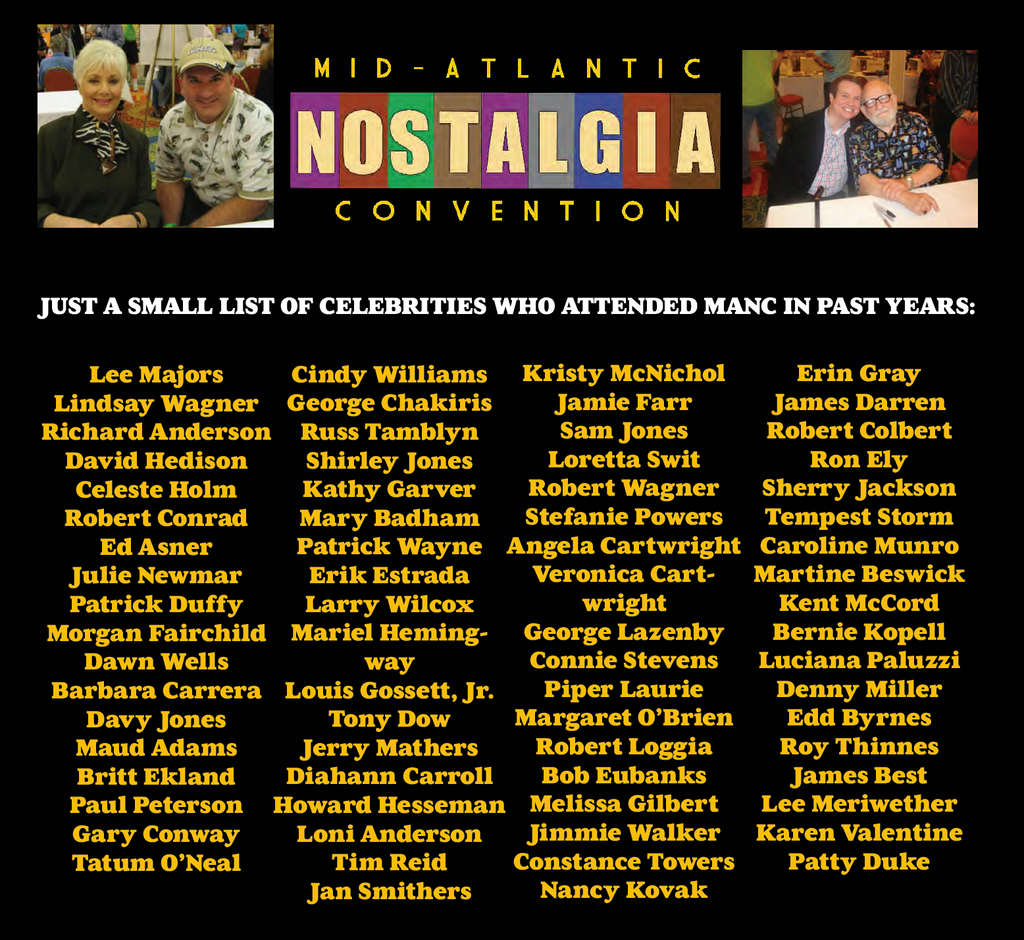
The Mid-Atlantic Nostalgia Convention is a three-day festival recognizing the bygone days when Pepsi Cola was five cents a glass bottle, hula hoops was the modern day Playstation and monster movies were a popular craze at the drive-in.
Attendees flock in from as far away as Canada, England, Belgium, Florida, St. Louis and California to attend this annual event.
Hollywood celebrities attend to sign autographs for the fans and pose for photographs.
A movie room screens rare classics 24 hours a day.
Almost 200 vendor tables offer a variety of movie posters, magazines, lobby cards, DVDs, VHS videos, books, old-time radio shows and much more.
Slide show seminars and panels all weekend offer a variety of informative subjects.
Anyone can attend the convention. Attendees can pay in advance or at the door, either way works for us.
Simply browse our website and check out the schedules of events, the re-creations on stage, charity auction, drive-in movie theater and much more we have to offer.
If you ever have any questions, please do not hesitate to contact us at 443-286-6821.
Share this info with friends:
Be sure to sign up for our FREE Newsletter!
* It’s sent out once or twice a month.
* It’s FREE to subscribe and you can unsubscribe anytime.
* Extensive coverage about the celebrities attending this year’s event!
* Tips about giveaways and contests you don’t want to miss!
* Reminders about deadlines so you don’t miss special discounts!
* News about recent nostalgia happenings.
* Fascinating articles.

It's a FREE Newsletter!
Even if you are a first time guest or planning your return visit, there is more to see and do than just walking through the vendor rooms and meeting the celebrities. The events for this year’s convention are still being drawn up and if you want to learn of the latest news, the newsletter is the best way to stay informed. If a new celebrity has been added at the last minute, you’ll know before everyone else!
We had someone once say they would not sign up because they don’t want to receive junk mail. We can assure you, this is NOT junk mail! If the hotel offered a super discount such as $20 a night and the offer was open only for 48 hours…. wouldn’t you want to be notified by e-mail? Don’t delay and sign up today! It doesn’t cost you anything!
Scroll over to the right side of the screen and sign up today!
If you have an iPhone or Android, you can scan the barcode below.

For Android and iPhones
* After you sign up, you will receive a notification via e-mail asking you to confirm. Please confirm as soon as you can else you won’t be signed up. And make sure the confirmation (and future Newsletters) won’t fall into your junk mail or spam folder so you won’t miss a single issue!
Share this info with friends:

Jonny Quest cartoon
Among the best of the 1960s animated television programs is Jonny Quest (often mis-spelled as “Johnny Quest” and often referred to as The Adventures of Jonny Quest), a short-run series from 1964-65, produced by Hanna-Barbera. Jonny Quest had everything going for it — action, adventure, suspense, comedy… and the creators of the program were obviously inspired by radio thrillers such as Jack Armstrong and I Love A Mystery and comic books that appealed to juveniles during the 1940s and 1950s. With the central character being a young boy, children could find a common bond — remember, even Captain America and Captain Midnight had children sidekicks for a reason. Shoreleave Hunt Valley
The cartoon gave the appearance of a comic book brought to life both through art and color… Jonny had yellow hair and wore a black tee shirt, Race wore a red shirt and had white hair and so on. Jonny was a young boy who went along on scientific travels with his father, Dr. Benton Quest, a scientist, who lived on a private island off the coast of Florida. The Quest family had a private lab and a hired gun — a bodyguard named Race Bannon. Jonny’s mother was assumed dead before the adventures because she is no where to be found or referenced on the program. Jonny’s best friend is Hadji, roughly of the same age, a Hindu who wears a turban and using the magic words “Sim Sala Bim” is able to levitate objects at will. Jonny’s father works for the government, but exactly in what capacity is never explained. Tagging along on the adventures is a small bulldog named Bandit, which provides the comic relief.

Jonny Quest cartoon
The Mystery of the Lizard Men
In one episode,”The Mystery of the Lizard Men,” Jonny and Race travel to the Sargasso Sea to discover why so many ships have been disappearing. They board an old deserted ship, where they are taken prisoner by The Chief and his men, whose frogmen outfits suggest the appearance of lizards. The Chief tells Race and Johnny that he has developed the laser gun into the ultimate weapon and has blasted the missing ships with it. Listening to The Chief, Jonny realizes he plans to use the laser to blast the first Man to the Moon shot, scheduled for that very day! Scooby-Doo Cartoons
Over the course of 26 half-hour episodes, the gang combats an assortment of villains such as a mummy in “The Curse of Anubis,” a giant robot spider in “The Robot Spy,” voodoo in “The Dreadful Doll,” and in “Turu the Terrible,” the Quest party is sent on an expedition to find Trinanuxite, a metal essential to the space program. Natives lead them into the Land of Turu, a hidden spot guarded by a giant pterodactyl. A wheelchair-bound man named Deen is using the creature to force the natives to mine the valuable ore. Dr. Zin’s henchmen using hovercrafts! The episode “Werewolf of the Timberland” suggested a real werewolf, until the guilty party masquerading as the monster was unmasked… a premise and format that would later be repeated for another Hanna-Barbera program, Scooby Doo. “The Invisible Monster” is a classic among fans because there really was an invisible monster, accidentally created in a lab and running amok killing everything it comes into contact. Jonny spills paint on the creature so everyone can see what they are combating.
One of the episodes featured an adult premise: “Shadow of the Condor,” in which the Quest party is forced to make an emergency landing in the Andes and encounters Baron Heinrich Von Froelich, a former World War I flying ace. The Baron offers Race one of his vintage fighting planes, but then follows him up and engages him in aerial combat. Since only Von Froelich has live ammunition, Race’s chances of survival appear slim until a giant condor appears and comes to his aid. The WWI ace wants to relive his glory days and has been so isolated in his mountain retreat that shades of Norma Desmond come into play… and subject matter that really wasn’t found on children’s programs of the time. Monster Bash 2013

Jonny Quest TV Series
The producers wanted to ensure lore and mythology was added to the program. Hadji’s origin is dramatized in “Calcutta Adventure,” Race has a girlfriend named Jade who appears in two episodes, and the gang has an arch nemesis, a rival scientist named Dr. Zin, who appears in four of the 26 episodes. Two subsequent television series, two movies and three video games have come along, as well as a series of comic books, but nothing beats (or captures) the feel of the original 1964-65 series. And this is a darn shame because each producer of the new animated versions apparently did not realize what made the original program so hip and cool. Producers have proven it is possible to reproduce the style, art and stories of vintage programs so why do they keep tampering with the format?
Most people do not know this but Jonny Quest was originally going to be Jack Armstrong, the All-American Boy, based on the popular old-time radio program from the 1930s and 40s. Hanna-Barbera even commissioned comic book artist Doug Wildey to create a five minute animated pilot using Popular Mechanics and other scientific magazines “to project what would be happening ten years” in the future, offering a futuristic rendition of the Jack Armstrong series. When Hanna-Barbera could not get permission from General Mills, owners of the Jack Armstrong character, following a promising screening of the test footage for GM executives, Wildey reworked the concept and created Jonny Quest.

Jack Armstrong
According to Wildey, inspiration came from the old Jackie Cooper and Frankie Darrow movies, cliffhanger serials, Milton Caniff’s Terry and the Pirates comic strip and the James Bond movie, Dr. No. As Wildey described in 1986, producer Joe Barbera had seen that first film about the English superspy “and wanted to get in stuff like [Bond's code-number] ’007′ — numbers. Which we included, by the way, in the first [episode of] Jonny Quest. It was called ‘Jonny Quest File 037′ or something. We dropped that later; it didn’t work. But that was his father’s code name as he worked for the government as a scientist and that kind of thing.” (Source, Amazing Heroes #95). Hanna-Barbera refused to give him a “created by” credit, probably for legal purposes so the studio wouldn’t owe long-term royalties, so Wildey instead received “Based on an idea created by” credit. The closing credits of every Jonny Quest episode began with scenes of two young boys escaping from African warriors by hovercraft, dodging deadly spears, escaping into a rocket which promptly closes doors moments before the spears hit the craft and bounce off, and the rocket launching into the air. Pictured above and on the left, these remain the only scenes in the closing credits not borrowed from episodes of Jonny Quest and for years puzzled fans as to their origin — they were clips from the five minute Jack Armstrong pilot with Jack Armstrong and Billy Fairfield (not Jonny and Hadji).

Jonny Quest DVD
Jonny Quest TV Series on DVD
You can purchase a complete series box set from Amazon.com which contains the complete 26 adventures from 1964-65. Like many commercial releases, the episodes were partially cut, re-edited and altered. Series creator Doug Wildey is not credited on 25 of the 26 episodes because the end credits for “Pursuit of the Po-Ho” are used for the closing of every episode. Why they did this remains a mystery since all the original masters clearly had their own individual credits. “Double Danger,” the one that differs, actually has the closing credits from “The Curse of Anubis.” Dialog from “Pursuit of the Po-Ho” and “Monster in the Monastery” was intentionally removed from the DVD set to avoid negative stereotyping. (To add insult to injury, the opening credits, a.k.a. the main titles, are a hybrid of the two versions of the main credits used during the show’s original run on ABC.) It is a darn shame Warner Video went to the trouble of altering the prints. Perhaps there was a legal reason? If you are not one to pay attention to the credits, the box set is, for the most part, as good as it gets. Monster Mania Convention Hunt Valley
Jonny Quest became a target of parental watchdog group Action for Children’s Television for its multiple onscreen deaths, murder attempts, use of firearms and deadly weapons, depictions of monsters, and tense moments. The Cold War-era fiction and yellow peril adventures add blood and thunder to a great program… which makes fans long for more. Jack Armstrong, the radio program, and the Terry and the Pirates newspaper strip, come the closest for additional excitement… until you discover the Rick Brant Electronic Adventures. (And if you don’t know where we are going with this, stay with me… you will get a kick out of this.)

Rick Brant novel
The Rick Brant Electronic Adventures
In 1947, the publishing house of Grosset & Dunlap released The Rocket’s Shadow, the first of what would become 24 adventure/mystery novels by John Blaine, a pseudonym for authors Harold L. Goodwin (all titles) and Peter J. Harkins (co-author of the first three). The final novel would be published in 1968. Best compared to as an imitation to the Hardy Boys novels, the mysteries involved science and the lead character, a young boy named Rick Brant, who was very knowledgeable with electronics. His experimental gadgets often came in handy, hence why the series was referred to as an “Electronic Adventure.” Rick Brant’s father, Hartson William Brant, was an engineer, a Master of the Arts, a member of numerous scientific societies, and a Fellow of the American Institute of Atomic Scientists. He worked for the U.S. Government and resided at a private home/laboratory where he conducted many of his experiments. The Brants lived on Spindrift Island, roughly oval shaped, located off the New Jersey Coast. Hartson Brant’s scientific projects often required traveling to far off countries and — you guessed it — combats international criminals, spies and villains. Batman TV reunion
Rick has a shaggy little dog named Dismal, a friend named Scotty who acted more like a bodyguard than a big brother, a Hindu named Chahda who occasionally traveled with them on their adventures… an arch nemesis named “Scarface” and… well, isn’t this starting to sound like Jonny Quest? Many fans have no doubts that Wildey was inspired by the novels, but nothing has been found to prove this and Hanna-Barbera wouldn’t admit it even if this was brought to their attention. Besides, who cares? Reading additional adventures of Jonny Quest in the form of Rick Brandt is worth the price (the early books go for about $4 to $5 a pop on Amazon).

Rick Brant novel
In The Rocket’s Shadow, the first novel in the series, Scotty was hired as an island guard and helped Rick solve the rocket mystery and trap the Spindrift traitor who was helping Manfred Wessel, a.k.a. “Scarface.” who was trying to thwart the Spindrift rocket so he could launch one of his own and thus win the $2 million dollar Stoneridge Grant. After the adventure of The Rocket’s Shadow, Scotty, who was an orphan, became an accepted member of the Spindrift Island family. In the second novel, The Lost City (also 1947), the two boys had gone with Professor Hobart Zircon and Professor Julius Weiss to High Tibet, to set up a radar transmitter for sending messages via the moon, courtesy of the controlled rocket launched at the conclusion of the last novel. They had succeeded only after overcoming many obstacles thrown in their way by the unscrupulous adventurer, Hendrick Van Groot, and the lost tribe of Mongols whose city was hidden in the Valley of the Golden Tomb, a.k.a. the tomb of Genghis Khan. At the conclusion of the second novel, Chahda wants to return to America and become a member of their family. Since he was instrumental in their rescue, the team agrees and makes the necessary arrangements.
In the third novel, Sea Gold, Rick and Scotty trap the saboteurs trying to wreck the plant where minerals are being extracted from the sea. The criminal turns out to be their arch nemesis who underwent plastic surgery to masquerade as someone else and avoid the “Scarface” name. In 100 Fathoms Under, the boys start a treasure hunt by Submobile in the depths of the Pacific Ocean, only to find themselves assisting Professor Gordon of the Bishop Museum explore Alta-Yuan, a sunken temple one hundred fathoms down — at the bottom of the sea. International crooks plan to steal the treasure and leave the Brandt gang on an island populated by dangerous natives.
If you enjoy the Jonny Quest series and long for action and adventure, and books that are difficult to put down because they are fun reads, look no further than the Rick Brant novels listed below. There is a bit of lure in each story so fans can chat about statistics: “No, remember that Scarface’s age was mentioned in the third adventure…” You can get them on Amazon.com and other online book stores for about five bucks or less (plus postage) and more if they have their original dust jackets — at least, that seems to be the average going price for them.
Rick Brant novels for sale, cheap prices
List of Rick Brant Electronic Adventures
The Rocket’s Shadow (1947)
The Lost City (1947)
Sea Gold (1947)
100 Fathoms Under (1947)
The Whispering Box Mystery (1948)
The Phantom Shark (1949)
Smuggler’s Reef (1950)
The Caves of Fear (1951)
Stairway to Danger (1952)
The Golden Skull (1954)
The Wailing Octopus (1956)
The Electronic Mind Reader (1957)
The Scarlet Lake Mystery (1958)
The Pirates of Shan (1958)
The Blue Ghost Mystery (1960)
The Egyptian Cat Mystery (1961)
The Flaming Mountain (1962)
The Flying Stingaree (1963)
The Ruby Ray Mystery (1964)
The Veiled Raiders (1965)
Rocket Jumper (1966)
The Deadly Dutchman (1967)
Danger Below! (1968)
Share this info with friends:

Deanna Durbin Motion Picture
by Leonard Maltin.
Deanna Durbin, a star whose songs and smile made her one of the biggest box-office draws of Hollywood’s Golden Age with fans that included Winston Churchill, has died. She was 91.
The only people who don’t like Deanna Durbin, it seems to me, are people who’ve never seen her movies. Possessed of a glorious, bell-like soprano voice, she was presented to moviegoers of the 1930s in a series of irresistible comedies that showcased a fresh, sunny screen personality. Delightful films like Three Smart Girls, One Hundred Men and a Girl, and Mad About Music were said to have saved Universal Pictures from bankruptcy; I don’t know if that’s actually true, but they were enormously successful, and her fans have remained devoted to her for decades.

Deanna Durbin
In 1946 she was the second-highest paid woman in America, but a few years later she walked away from the spotlight, moved to France, and refused most requests for interviews for the rest of her life. She did respond to some fan letters, however, and one notable admirer, film historian William K. Everson, touched a responsive chord when he asked her about working with director Jean Renoir on The Amazing Mrs. Holliday (1943). He later published an article in Films in Review magazine based on her fond recollections of the master filmmaker, whom she considered a great artist, and her regret that he and Universal didn’t see eye-to-eye about the picture. Producer Bruce Manning stepped in, and received sole credit for the finished film.
Durbin’s few public statements in later years revealed a bitterness about her youthful film career, and a disbelief that anyone her age could have related to the unfailingly cheerful persona that producer Joe Pasternak, director Henry Koster, and a team of writers (including one of her future husbands, Felix Jackson) devised for her.

Deanna Durbin
What a shame that she never appreciated how much happiness she provided to moviegoers of all ages.
As to who might have related to the optimistic character she played so often, my friend Eric Schwartz (a prominent entertainment lawyer) recalls, as a teenager, asking his parents, “Who is that girl in the pictures on the wall in Anne’s room?” while on a tour of the Anne Frank house in Amsterdam. It was, of course, Deanna Durbin.
Share this info with friends:

Jonathan Winters
Jonathan Winters, the cherub-faced comedian whose breakneck improvisations and misfit characters inspired the likes of Robin Williams and Jim Carrey, has died. He was 87. The Ohio native died Thursday evening at his Montecito, Calif., home of natural causes, said Joe Petro III, a longtime family friend. Petro said Winters died surrounded by family and friends.
Winters was a pioneer of improvisational standup comedy, with an exceptional gift for mimicry, a grab bag of eccentric personalities and a bottomless reservoir of creative energy. Facial contortions, sound effects, tall tales — all could be used in a matter of seconds to get a laugh. On Jack Paar’s television show in 1964, Winters was handed a foot-long stick and he swiftly became a fisherman, violinist, lion tamer, canoeist, U.N. diplomat, bullfighter, flutist, delusional psychiatric patient, British headmaster and Bing Crosby’s golf club.
“As a kid, I always wanted to be lots of things,” Winters told U.S. News & World Report in 1988. “I was a Walter Mitty type. I wanted to be in the French Foreign Legion, a detective, a doctor, a test pilot with a scarf, a fisherman who hauled in a tremendous marlin after a 12-hour fight.”
The humor most often was based in reality — his characters Maude Frickert and Elwood P. Suggins, for example, were based on people Winters knew growing up in Ohio. A devotee of Groucho Marx and Laurel and Hardy, Winters and his free-for-all brand of humor inspired Johnny Carson, Billy Crystal, Tracey Ullman and Lily Tomlin, among others. But Williams and Carrey are his best-known followers.

It’s a Mad Mad Mad Mad World
Winters, who battled alcoholism and depression for years, was introduced to millions of new fans in 1981 as the son of Williams’ goofball alien and his earthling wife in the final season of ABC’s “Mork and Mindy.” The two often strayed from the script. Said Williams: “The best stuff was before the cameras were on, when he was open and free to create. … Jonathan would just blow the doors off.”
Winters’ only Emmy was for best-supporting actor for playing Randy Quaid’s father in the sitcom Davis Rules (1991). He was nominated again in 2003 as outstanding guest actor in a comedy series for an appearance on Life With Bonnie.
He also won two Grammys: One for his work on The Little Prince album in 1975 another for his Crank Calls comedy album in 1996. He also won the Kennedy Center’s second Mark Twain Prize for Humor in 1999, a year after Richard Pryor.
Winters was sought out in later years for his changeling voice and he contributed to numerous cartoons and animated films. Fittingly, he played three characters in the The Adventures of Rocky and Bullwinkle movie in 2000. “These voices are always screaming to get out,” he told the Fort Worth Star-Telegram that year. “They follow me around pretty much all day and night.”

The Shadow (1994)
Winters had made television history in 1956, when RCA broadcast the first public demonstration of color videotape on “The Jonathan Winters Show.” Winters quickly realized the possibilities, author David Hajdu wrote in The New York Times in 2006. He soon used video technology “to appear as two characters, bantering back and forth, seemingly in the studio at the same time. You could say he invented the video stunt.”
Winters was born Nov. 11, 1925, in Dayton, Ohio. Growing up during the Depression as an only child whose parents divorced when he was 7, Winters spent a lot of time entertaining himself. Winters described his father as an alcoholic. But he found a comedic mentor in his mother, radio personality Alice Bahman. “She was very fast. Whatever humor I’ve inherited I’d have to give credit to her,” Winters told the Cincinnati Enquirer in 2000. Winters joined the Marines at 17 and served two years in the South Pacific. He returned to study at the Dayton Art Institute, helping him develop keen observational skills. At one point, he won a talent contest (and the first prize of a watch) by doing impressions of movie stars.
After stints as a radio disc jockey and TV host in Ohio from 1950-53, he left for New York, where he found early work doing impressions of John Wayne, Cary Grant, Marx and James Cagney, among others. One night after a show, an older man sweeping up told him he wasn’t breaking any new ground by mimicking the rich or famous. “He said, ‘What’s the matter with those characters in Ohio? I’ll bet there are some far-out dudes that you grew up with back in Ohio,’” Winters told the Orange County Register in 1997. Two days later, he cooked up one of his most famous characters: the hard-drinking, dirty old woman Maude Frickert, modeled in part on his own mother and an aunt. The character was the forerunner of Johnny Carson’s Aunt Blabby.

Jonathan Winters voices The Smurfs
Appearances on Paar’s show and others followed and Winters soon had a following. And before long, he was struggling with depression and his drinking. “I became a robot,” Winters told TV critics in 2000. “I almost lost my sense of humor … I had a breakdown and I turned myself in (to a mental hospital). It’s the hardest thing I’ve ever had to do.”
Winters was hospitalized for eight months in the early 1960s. It’s a topic he rarely addressed and never dwelled on. When he got out, there was a role as a slow-witted character waiting in the 1963 ensemble film It’s a Mad, Mad, Mad, Mad World.
“I finally opened up and realized I was in charge,” Winters told PBS interviewers for 2000′s Jonathan Winters: On the Loose. ”Improvisation is about taking chances, and I was ready to take chances.” Roles in other movies followed, as did TV shows, including his own. But while show business kept Winters busy, he stayed with his painting.
“I find painting a much slower process than comedy, where you can go a mile a minute verbally and hope to God that some of the people out there understand you,” he told U.S. News and World Report in 1988. “I don’t paint every day. I’m not that motivated. I don’t do anything the same every day. Discipline is tough for a guy who is a rebel.”
Among his books is a collection of short stories called Winters’ Tales (1987). He also was a painter.
“I’ve done for the most part pretty much what I intended — I ended up doing comedy, writing and painting,” he told U.S. News. “I’ve had a ball. And as I get older, I just become an older kid.”
Share this info with friends:

Julie Newmar as Catwoman
“Tell me I’m beautiful, it’s nothing. Tell me I’m intellectual – I know it. Tell me I’m funny and it’s the greatest compliment in the world anyone could give me.”
– Julie Newmar
Julie Newmar is widely remembered for her role as Cat Woman on the iconic television series, Batman. Film buffs know her as Dorcas, one of the seven beautiful brides in the 1954 classic, Seven Brides for Seven Brothers. A brief stint as a gold-painted exotic dancer in Serpent of the Nile (1954) is usually overlooked by Newmar’s biographers, who prefer to list Seven Brides for Seven Brothers as her screen debut. In actuality, Newmar appeared in a total of nine motion-pictures prior to the musical… her first as a chorus girl named “Julie” in She’s Working Her Way Through College (1952).

Julie Newmar
A lifelong student of ballet, Newmar was accepted as a dancer by the Los Angeles Opera Company at age 15, and soon became prima ballerina. Always ambitious, she studied philosophy and French at UCLA, before leaving to try her luck in films. Seven Brides for Seven Brothers tells the story of Adam, the eldest of seven brothers, who goes to town to get a wife. He convinces Milly to marry him that same day. They return to his backwoods home. Only then does she discover he has six brothers — all living in his cabin. Milly sets out to reform the uncouth siblings, who are anxious to get wives of their own. Then, after reading about the Roman capture of the Sabine women, Adam develops an inspired solution to his brothers’ loneliness. The movie took 48 days to film, both in CinemaScope and the standard screen ratio of the day. (Both versions are available on the 2004 DVD release.) Many of the actors’ singing voices were dubbed in this movie: Matt Mattox’s singing was dubbed by Bill Lee, Nancy Kilgas’s singing was dubbed by Marie Greene, and Julie Newmar’s singing was dubbed by Betty Allen.

Seven Brides for Seven Brothers
Newmar had first appeared on Broadway in 1955 in Silk Stockings which starred Hildegarde Neff and Don Ameche. She also appeared in the 1961 play, The Marriage-Go-Round, which starred Charles Boyer and Claudette Colbert. Newmar developed the role of the Swedish vixen and won a Tony Award for Best Supporting Actress. She later appeared on stage with Joel Grey in the national tour of Stop the World – I Want to Get Off and as “Lola” in Damn Yankees! and “Irma” in Irma La Douce.

The Twilight Zone
Julie Newmar made the transition to television and began appearing on The Phil Silvers Show, Adventures in Paradise, and played the Devil in an episode of The Twilight Zone. In 1962, Newmar appeared twice as motorcycle-riding, free-spirited heiress Vicki Russell on Route 66, filmed in Tucson, Arizona (“How Much a Pound is Albatross”) and in Tennessee (“Give the Old Cat a Tender Mouse”). In 1964, Newmar signed for the role of Rhoda Miller, an extremely sexy young woman living with womanizing Air Force shrink Bob McDonald (played by Bob Cummings). What Bob knows and the rest of the world does not is that Rhoda’s real name is AAF709, and she is actually a sophisticated (yet naive) robot. Bob’s job is to teach Rhoda how to be a “perfect” woman, and keep her identity secret from the world — especially from lecherous neighbor Peter. When actor Bob Cummings left the series in early 1965, his character was written out of the series, and Peter was given the duty of taking care of Rhoda.

My Living Doll DVDs
Robert Cummings walked off the show several episodes prior to the end of production of the first and only season. Although a rumor exists that he and Julie Newmar did not get along, Newmar and the show’s producer dispute this on the 2012 DVD release. For years, most episodes of the series were thought to be lost, except for six episodes that survived in collector hands. Many reports have it that Jack Chertok threw away the elements; not so as CBS was entrusted with the 35mm masters. In fact, all of the episodes existed until their 35mm masters were destroyed in the Northridge Earthquake of 1994. The 2012 DVD release features 12 episodes that have been obtained from various sources and the remaining 14 episodes are now being highly sought after.
Fans of F Troop recall Julei Newmar in the title role of the classic “Yellow Bird” episode. A white woman raised by Indians, Yellow Bird, starts to take after the Captain. On a first season episode of The Monkees, “Monkees Get Out More Dirt,” all four of the Monkees fall in love with the same girl, April Conquest (played by Newmar), of the local laundromat. Each one of them tries to woo her by feigning interest in things she likes: Davy paints pop-art, Mickey performs ballet, Peter plays chamber music while Mike rides a bike. In the fourth season episode of Get Smart, “The Laser Blaster,” Newmar played the role of Ingrid. When Maxwell Smart is sent to Hong Kong to pick up a secret weapon and all they give him is a blazer. This blazer is special since it contains a laser and Max doesn’t know it.

Julie Newmar in Star Trek
Star Trek fans remember Newmar in the role of Eleen in the episode “Friday’s Child.” The Federation is in competition with the Klingons for an alliance with the inhabitants of Capella IV. The Capellans are a warrior tribe and there is dissension among them as to who to sign the mining rights treaty with. McCoy is familiar with their customs having once spent several months there. When a Capellan, who clearly favors the Klingons, stages a coup, Kirk, Spock and McCoy flee with the now dead leader’s wife (Newmar), who is about to give birth.
In 1966, Julie Newmar was offered the role of Cat Woman on Batman and almost overnight she became a pop icon. Newmar had not ever heard of “Cat Woman” before she auditioned for the role. The Cat Woman is one Batman’s earliest comic book adversaries, initially appearing in Batman #1 (Spring 1940), and became the best-known and most frequently seen Batman villain. Suzanne Pleshette was one of the original choices to play Cat Woman before Julie Newmar landed the role.

Julie Newmar as Catwoman
“I had lived in New York at the time on Beekman Place,” Newmar later recalled. “I remember it was a weekend, Friday or Saturday, and my brother had come down from Harvard with five or six of his friends, and we were all sitting around the sofa, just chatting away, when the phone rang. I got up and answered it, and it was this agent or someone in Hollywood, who said, ‘Miss Newmar, would you like to play Cat Woman on the Batman series? They are casting it out here.’ I was insulted because he said, ‘It starts Monday.’ I said, ‘What is this?’ That’s how television is done: they never know what they are doing until yesterday. Well, my brother leaped off the sofa. I mean he physically levitated and said, ‘Batman! That’s the favorite show at Harvard. We all quit our classes and quit our studies and run into the TV room and watch this show.’ I said, ‘They want me to play Cat Woman.’ He said, ‘Do it!’ So, I said, ‘OK, I’ll do it.’

MacKenna’s Gold
Due to her role in Mackenna’s Gold she was unable to play Cat Woman in the third series so Eartha Kitt took over. Some of ABC’s southern affiliates objected to the casting of Kitt, but Charles B. Fitzsimons’ said he and the show’s other producers didn’t care about the issue.
Newmar appeared in several low-budget films during the next two decades and guest-starred on television, appearing on The Love Boat, Buck Rogers in the 25th Century, Hart to Hart, CHiPs, Fantasy Island, Columbo and The Bionic Woman. She was seen in George Michael’s video clip Too Funky in 1992, and appeared as herself in a 1996 episode of Melrose Place.
MOVIE APPEARANCES
- Just for You (1952)
- Serpent of the Nile (1953)
- The Band Wagon (1953)
- Slaves of Babylon (1953)
- Demetrius and the Gladiators (1954)
- Seven Brides for Seven Brothers (1954)
- Li’l Abner (1959)
- The Rookie (1959)
- The Marriage-Go-Round (1961)
- For Love or Money (1963)
- Mackenna’s Gold (1969)
- The Maltese Bippy (1969)
- Mother (1970)
- Hysterical (1983)
- Love Scenes (1984)
- Streetwalkin’ (1985)
- Evils of the Night (1985)
- Deep Space (1987)
- Nudity Required (1988)
- Body Beat (1988)
- Cyber-C.H.I.C. (1989)
- Ghosts Can’t Do It (1990)
- Oblivion (1994)
- To Wong Foo, Thanks for Everything! Julie Newmar (1995, cameo)
- Oblivion 2: Backlash (1996)
- If… Dog… Rabbit… (1999)
TELEVISION APPEARANCES
- The Phil Silvers Show (1957)
- Route 66 (1962)
- The Twilight Zone (1963)
- My Living Doll (1964–1965)
- Batman (1966)
- The Monkees (1966)
- Star Trek (1966)
- Get Smart (1968)
- It Takes a Thief (1968)
- McCloud (1970)
- Bewitched (1971)
- The Feminist and the Fuzz (1971)
- A Very Missing Person (1972)
- Columbo: Double Shock (1973)
- Sin, American Style (1974)
- Terraces (1977)
- Jason of Star Command (1978)
- Buck Rogers in the 25th Century (1979)
- Return to the Batcave: The Misadventures of Adam and Burt (2003)
- According to Jim (2006)
- Batman: The Brave and the Bold (2010)

Julie Newmar as Catwoman

My Living Doll

Julie Newmar

Julie Newmar

William Shatner and Julie Newmar

Julie Newmar

Julie Newmar in Li’l Abner

Bob Cummings and Julie Newmar

Julie Newmar as Catwoman

Route 66

Julie Newmar in Li’l Abner
Share this info with friends:

Annette Funicello
Paul Anka wrote the song “Puppy Love” about his romance with her. When she was cast in her first beach movie, Walt Disney asked her to not wear a bikini and instead wear a one-piece swimsuit because she had an image to uphold… she agreed. “The Disney studio wasn’t like other studios. It was just like home – it always had a small-town, family atmosphere.” Annette Funicello, one of the best-known members of the original 1950s “Mickey Mouse Club” and a star of numerous 1960s “beach party” films, died Monday at a California hospital.
Funicello, who was 70, “died peacefully from complications due to multiple sclerosis, a disease she battled for over 25 years,” according to an official statement from the Walt Disney Company.
“We are so sorry to lose Mother,” her three children said in a statement. “She is no longer suffering anymore and is now dancing in heaven. We love and will miss her terribly.” Hardy Boys television

Annette Funicello
Walt Disney saw her dancing the lead in “Swan Lake” at the Starlight Bowl in Burbank when she was 13. He asked her to audition for a new children’s TV series he was developing called The Mickey Mouse Club. She was hired on the spot to become a Mouseketeer. With a background in dance and a natural talent for projecting herself on television, she quickly became one of the most popular Mouseketeers. She remained with Disney after leaving the The Mickey Mouse Club, appearing in TV shows including Zorro (1957), The Nine Lives of Elfego Baca (1958) and starring in the Disney feature films The Shaggy Dog (1959), Babes in Toyland (1961), The Misadventures of Merlin Jones (1964) and The Monkey’s Uncle (1965). In love with Guy Williams and a fan of the Zorro television series, when asked by Walt Disney what she would like for her birthday, Funicello said she would like to make a guest appearance on the series. Disney granted her wish.
The most enduring images of Funicello, though, may be of her in a bikini, her primary wardrobe when she co-starred with teen idol Frankie Avalon in beach party movies in the early 1960s. These included Beach Party (1963), Muscle Beach Party (1964), Bikini Beach (1964), Beach Blanket Bingo (1965), and How to Stuff a Wild Bikini (1965). A combination of bikini-clad women and rock and roll music soon inspired many imitations… almost all of them unforgettable because they did not have Annette Funicello. Monster Mania Batman Maryland

Annette Funicello’s “Hawaiiannette”
The beach party movies helped sell her music. She had a number of Top-40 hits including “Tall Paul,” “First Name Initial,” “How Will I Know My Love,” and “Pineapple Princess.” Along with the singles, she recorded several successful albums, including “Hawaiiannette” (1960), “Italiannette” (1960) and “Dance Annette” (1961).
She married twice and had three children. In 1987, she was diagnosed with Multiple Sclerosis. Five years later, she was struggling with walking and went public with the disease. “My life has always been filled with happiness,” she told a reporter for the Los Angeles Times. What she knew from the fan mail was she made millions happy with her charming personality and silver screen talent.
CNN headline news

Beach Party Movies
TRIVIA
When she began working for the Disney studio, she suggested to her employer that she change her Italian family name of Funicello to something more “American,” as was often done in those days. Walt Disney vehemently argued against this idea, saying that her own name was actually an asset because it was so unique that no one who heard it would ever be able to forget it and convinced the young actress to retain it.
The Mickey Mouse Club
Turner Classic Movies
The Memphis Film Festival
Shore Leave Convention
Shore Leave 35 Hunt Valley

Annette Funicello
Share this info with friends:
THURSDAY

Yours Truly, Johnny Dollar
9:00 am, YOURS TRULY, JOHNNY DOLLAR
A Deeper Look at the Radio Program
John C. Abbott, author of The Who is Johnny Dollar Matter, will present a closer look at the radio program that continues entertaining old-time radio buffs today. Johnny Dollar (1949-1962) was a freelance insurance investigator who proved to have more lives than a cat. His “expense account” was always itemized in every episode and all murders were exposed to the authorities courtesy of the detective fare of Johnny Dollar. It was great radio and John C. Abbott will offer us a great presentation.

Poster Art
10:00 am, GRACIE ALLEN: Her Bid For Presidency in 1940
Sally Stephens will present a program that will focus on Gracie Allen’s bid for the presidency in 1940. She will be putting her farcical election bid in real-life 1940 context, and track her campaign through the Burns and Allen program, Gracie’s appearances on other radio programs, and the culmination of it all at the Surprise Party convention in Omaha. A superb slide show done at the Metro Washington Old-Time Radio Club a few months back and received rave reviews. Come watch a lighthearted look at politics on radio!
Thor: The Dark World (2013)

Dick Tracy book
11:00 am, DICK TRACY IN THE COMICS
Garyn Roberts, author of Dick Tracy and American Culture (2003), will provide us a fascinating slide show about the famous comic strip that debuted in October 1931. Since then America’s most famous crime fighter has tangled with a variety of protagonists from locations as diverse as the inner city and outer space, all the time maintaining the oral high ground while reflecting American popular culture. From Pruneface, Mumbles, Big Boy, Itchy and Flattop, Dick Tracy went up against many deadly foes and through extensive research and interviews with Chester Gould (the creator of “Dick Tracy”), his assistants, Dick Locher (the current artist), Max Allan Collins (who scripted the stories for more than 15 years), and many others associated with the strip, Dick Tracy as a cultural icon will emerge on the big screen. Garyn Roberts will be our 2013 Guest of Honor. Limited quantity of his book will be available at the convention.
-

James Rosin
12:00 noon. ON ACTING: AUDITIONING FOR FILM/TELEVISION
Have you ever wondered what it takes to work in front of the camera? It’s no secret that Robert Downey Jr. took ballet lessons when he wanted to become an actor. But there’s more to acting than dancing.
Actor and author Jim Rosin, who made guest appearances on Quincy M.E. and Adam-12, among others, takes you through the process of auditioning for movie and television roles and discusses the do’s and don’ts once you are handed the scene pages and encounter the casting director, producer and director. (Q &A discussion to follow.)
1:00 p.m., INTERVIEWS WITH THE CELEBRITIES
Details to be announced.

The Gotham Radio Players
4:00 p.m., THE GOTHAM RADIO PLAYERS — OLD-TIME RADIO RECREATION
An old-time radio recreation complete with scripts, sound effects and music will be dramatized on stage!
Name of drama to be announced.
5:00 p.m., INTERVIEW WITH CELEBRITIES
Details to be announced.

Meet Me in St. Louis
8:00 p.m., SPECIAL SCREENING OF MEET ME IN ST. LOUIS (1944)
In the year before the 1904 St Louis World’s Fair, the four Smith daughters learn lessons of life and love, even as they prepare for a reluctant move to New York.
Weekend guest Margaret O’Brien will introduce the classic motion picture and answer questions from the audience. Even if you saw the movie a hundred times, watching it from another perspective after Margaret O’Brien shares her recollections, memories and behind-the-scenes stories is worth a night at the movies!
FRIDAY

The Rocketman Book
9:00 am, “STAND BY, SPACE RANGERS”: 1950s Rocketmen TV Series and their Fans
Remember Rocky Jones, Buzz Corey, Tom Corbett and Captain Z-Ro? These space heroes, along with their sidekicks and crews brought fantastic adventures and real world lessons about what it was meant to be an American during the Cold War. Every week the interplanetary adventures were brought into their living room. Author Cynthia Miller will take you back to the days of the TV rocket men, in a talk about these series, their impact on fans, the promotional culture of the day and the real world space program.
Turner Classic Movies Film Festival 2014

Audrey Totter
10:00 am, FILM NOIR AND AUDREY TOTTER
Gene Blottner, author of Columbia Pictures Film Noir, 1940 – 1962 (McFarland Publishing), will provide a view of one of filmdom’s greatest film noir actresses, Audrey Totter. All her film noir features will be covered from Bewitched (voice only, MGM, 1945) to her western noir, Man or Gun (Republic, 1958). Audrey played various film noir roles such as magazine editor Adrienne Fromsett in Lady in the Lake (MGM, 1947), psychiatrist Dr. Ann Lorrison in High Wall (MGM, 1947), floozy Donna Allen in Alias Nick Beal (Paramount, 1949) and femme fatale Claire Quimby in Tension (MGM, 1949). Trivia: Lady in the Lake was Audrey Totter’s first film noir lead. The film would be presented through star Robert Montgomery’s eyes. Audrey won out because of her radio experience, she knew how to play to a microphone.
11:00 am, ENTERTAINING SPIRITS: The Many TV Adaptations of Charles Dickens’ A Christmas Carol

Christmas on TV
Author of Tis the Season TV: the Encyclopedia of Christmas-Themed Episodes, Specials, and Made-for-TV Movies, Joanna Wilson presents a fascinating and entertaining survey of television’s many adaptations, aberrations, and re-imaginings of A Christmas Carol. TV has added its own special stamp to Charles Dickens’ beloved Christmas tale, and Wilson will take TV fans on a guided tour of some of the best and most interesting Christmas Carol iterations through TV history–from Rod Serling’s rarely seen 1964 version, Carol for Another Christmas, to the first animated TV Christmas special, Mr. Magoo’s Christmas Carol, to outrageous sitcom adaptations such as Bewitched, Sanford and Son, Family Ties, and much more. Joanna Wilson is the author of three books, The Christmas TV Companion (2009, 1701 Press), Tis the Season TV (2010, 1701 Press), and Merry Musical Christmas, Volume One (2013, 1701 Press). She has appeared in the TV Guide Network special, “25 Most Hilarious Holiday TV Moments” and in The History Channel special, “The Real Story of Christmas,” both of which aired in 2010. She writes a popular blog about her adventures in Christmas TV Land at http://ChristmasTVHistory.com.

Ray Bradbury
12 noon, RAY BRADBURY TRIBUTE
Ray Bradbury was an American science fiction writer whose works were translated in more than 40 languages and sold millions of copies around the world. Although he created a world of new technical and intellectual ideas, hover craft and various space transport, he never obtained a driver’s license and had never driven a car. Surprised? Well, you’ll learn a lot more about Ray Bradbury from our weekend Guest of Honor, Garyn Roberts, who will offer us a fascinating presentation about the man who changed the way we look at the world.

Blondie Goes to Hollywood
1:00 p.m., “BLONDIE” IN THE COMICS AND ON CINEMA
It was the longest running film series on Chic Young’s famous comic strip that ran from 1938 to 1950 through Columbia Pictures. The 28 movies starred Penny Singleton, Arthur Lake, Larry Simms, Daisy, Danny Mummert and Jonathan Hale. Marjorie Ann Mutchie, Daisy’s pups and Jerome Cowan were added to the cast later. What made the film series so successful? Carol Lynn Scherling, the author of Blondie Goes to Hollywood, will answer this question. (We’ll also be screening one of the Blondie movies this weekend so be sure to catch that as well!)
2:00 p.m., OLD-TIME RADIO TRYOUTS
Come try out for a role on stage in an old-time radio recreation. Under the superb direction of Don Ramlow, script readings and rehearsals begin at 2 p.m. and you might have the opportunity to perform on stage! Come show up and test your vocal chords!
3:30 p.m., OLD-TIME RADIO RECREATION
Details to be announced.

St. Jude Children’s Research Hospital
4:00 p.m., CHARITY AUCTION FOR THE ST. JUDE CHILDREN’S RESEARCH HOSPITAL
Let’s try to break a record and raise a lot of money for children with treatable cancer! Numerous items donated by celebrities and attendees will be on display all day Friday and at 4:30, we’ll make the items available for sale to the winning bidder. One hundred percent of the money raised will go to the St. Jude Children’s Research Hospital. If you plan to donate items for the auction, simply bring them to the show and put them on the tables any time Friday. And for those of you who helped donate money or items last year, thank you very much for making last year’s auction a big success!
5:00 p.m., INTERVIEWS WITH THE CELEBRITIES
Details to be announced.
6:00 p.m., A GOOD OLD FASHIONED SOCK HOP
Details to be announced.

The Blob (1958)
Sunset, DRIVE-IN MOVIE THEATER…. THE BLOB (1958)
Outside in the hotel parking lot we’ll have a drive-in movie theater. This year’s offering is the 1958 classic, The Blob. A mysterious creature from another planet, resembling a giant blob of jelly, lands on earth. The people of a nearby small town refuse to listen to some teenagers who have witnessed the blob’s destructive power. In the meantime, the blob just keeps on getting bigger. With Steve McQueen in the cast, and a special cartoon before the movie (Abbott and Costello Meet the Blob), how can you not miss an opportunity to enjoy a drive-in classic? Sunset is officially 7:04 p.m., by the way.
SATURDAY

Orson Welles
9:00 a.m., ORSON WELLES ON TELEVISION
Orson Welles is known primarily for film masterpieces such as Citizen Kane and Touch of Evil, ad secondarily for his radio work (War of the Worlds, etc.). Often overlooked and least explored is Welles’ prolific career in television. Most of us of a certain age remember his appearances with Merv Griffin, Dean Martin and the popular Paul Masson wine commercials. But prior to hitting the talk show circuit, Welles had a prolific career in European and U.S. television as host, actor and director. Rob Farr will show clips from these rare programs and offer commentary and trivia on those that bear Welles’ unmistakable stamp as a director.

Jack French
10:00 a.m., THE FBI ON THE AIR WAVES
Presentation by Jack French. Starting in 1932, network radio featured programs portraying the FBI in its war against crime and subversion. Retired FBI Agent Jack French will discuss all of these radio series….some of which were sanctioned by the Bureau, most of which were not. The factual strengths and weaknesses of these “G-Man” programs will be examined, including how they fared with the listening audiences over the years. The historical background of shows like “The FBI in Peace and War”, “Junior G-Men”, “I Was a Communist for the FBI” and others will all be covered during this informative presentation.
11:00 a.m., METRO WASHINGTON OLD-TIME RADIO CLUB MEET
Details to be announced.

Hank Williams
12 noon, HANK WILLIAMS ON RADIO & TV
Presentation by Michael J. Hayde. On January 1, 1953, singer Hank Williams died in the back seat of a Cadillac while traveling to a performance. Already considered one of country music’s greatest stars during his lifetime, his legacy and legend has only grown in stature in the 60 years since his death. While his many recordings for MGM Records have been reissued constantly, “Ol’ Hank” had a prolific career in radio and even appeared on network television. This presentation showcases recordings of Williams on “The Grand Ole Opry,” “The Louisiana Hayride,” “The Health and Happiness Show” and “The Mother’s Best Program.” You’ll also hear a rare public service broadcast, “Stars in Her Eyes,” which was – believe it or not – a melodrama about syphillis that Hank narrated, both spoken and in song. Some kinescope footage of Williams will be included, as well as radio coverage of his untimely death (he was 29 years old) and funeral service.
1:00 p.m., TO BE ANNOUNCED

Captain Chesapeake
2:00 p.m., “AHOY CREWMEMBERS!”
A retrospective of George Lewis, Baltimore’s own CAPTAIN CHESAPEAKE (and the Ghost Host)
Hosted by Gene Crowell. The late George Lewis had been a staple in the Baltimore region since 1971 as the long running “Captain Chesapeake.” For close to 20 years, “Captain C”, with his cast of accompanying characters, entertained kiddies by hosting morning and afternoon cartoon and live action children shows. And who can forget his commercial spots for several regional products? For the older kids, Lewis hosted Saturday evening horror movies as the Ghost Host. Join us for this fascinating talk on the legacy on one of our beloved Baltimore icons of the 70s and 80s. You’ll feel like a crew member again!

The History of Vitaphone
3:00 p.m., THE HISTORY OF VITAPHONE
Vitaphone was a sound film system used for feature films and nearly 1,000 short subjects made by Warner Brothers and its sister studio First National from 1926 to 1931. Vitaphone was the last major analog sound-on-disc system and the only one which was widely used and commercially successful. The soundtrack was not printed on the film itself, but issued separately on phonograph records. The discs, recorded at 33 1/3 rpm (a speed first used for this system) and typically 16 inches in diameter, would be played on a turntable physically coupled to the projector motor while the film was being projected. Many early talkies, such as The Jazz Singer (1927), used the Vitaphone system. The name “Vitaphone” derived from the Latin and Greek words, respectively, for “living” and “sound.” Ron Hutchinson of The Vitaphone Project, will give film buffs a rare treat — the history of Vitaphone!
All presentations, panels and slide show seminars are subject to change. The schedule will be finalized by April 30.
Yes, we will have the annual cartoon showing!
Share this info with friends:

Roger Ebert, film critic
With his fellow reviewer and sometime sparring partner Gene Siskel, Roger Ebert could make or break the financial success of a motion-picture with their trademark “two thumbs up,” a catch phrase that was spoofed on In Living Color, Saturday Night Live, The Simpsons… and became a catch phrase on movie posters and television commercials promoting the movie.
In September 2001, Citizen Kane was released on DVD and among the audio commentary was Robert Ebert who provided a fascinating review of the motion picture and more importantly, the visual craftsmanship that most fans of the movie probably overlooked even after repeat viewings. Rent the DVD and watch the movie. Then watch the movie a second time and listen to Ebert’s commentary. Your admiration for the man will grow with each passing moment.
In 1975 Ebert became the first film critic to win a Pulitzer Prize, for his movie reviews in the Sun-Times. In the same calendar year, Ebert was asked to appear on WTTW, the public broadcasting station in Chicago, as co-host of a new movie-review program. He was intrigued, but then taken aback when told that Gene Siskel, the film critic of The Chicago Tribune, would be his partner. “The answer was at the tip of my tongue: no,” Ebert told Time magazine in 1987.
As for Mr. Siskel, he said he initially had no desire to team up with “the most hated guy in my life.” Thor: The Dark World (2013)

“The Great Movies” by Roger Ebert
But the pairing worked. The show, originally titled Opening Soon at a Theater Near You, was a public television hit. It evolved into Sneak Previews, which went national when the Public Broadcasting Service began syndicating it in 1978. It eventually attracted more viewers than any other entertainment series in the history of public television. Seeing its commercial potential, Tribune Entertainment acquired the show in 1982 and syndicated it under the title At the Movies. In 1986, Ebert and Siskel signed a contract with Buena Vista Television to syndicate the program under the titles Siskel & Ebert at the Movies. For all their combativeness, however, they actually agreed on a movie’s worth much more often than they differed.
Siskel died of a brain tumor in 1999 at 53. Afterward, the show was renamed Roger Ebert & the Movies and began rotating co-hosts as a way of auditioning them. In September 2000, Richard Roeper, a fellow Sun-Times columnist, became the permanent co-host and the show was renamed Ebert & Roeper. Ebert left the show in 2006 because of his illness.
Roger Ebert grew up at a time most people of his generation fondly remember the luxurious movie palaces. The first movie he saw was the 1937 Marx Brothers comedy, A Day at the Races, at the Princess Theater in Urbana, Illinois. “It was part of a double feature shown with five cartoons, and you got four and a half hours of solid entertainment for exactly nine cents,” he once recalled.

Roger Ebert
Besides reviewing movies, Ebert has a screen writing career. He wrote the screenplay for the 1970 movie Beyond the Valley of the Dolls for Russ Meyer, a director known for his campy B-flicks featuring busty women. Panned by fellow critics (“gratuitously violent,” Siskel reviewed), the film seemed a point of pride for Ebert, who was paid $15,000 and never tired of talking about it. He wrote a half-dozen more screenplays for Mr. Meyer, one of which was produced: Beneath the Valley of the Ultra-Vixens (1979).
Roger Ebert wasn’t the only person to speak out against the Motion Picture Association of America’s rating system, saying it lurched between being too restrictive and too lenient. He publicly criticized Hollywood for not supporting documentaries and relying too much on digital effects and what he called gimmicks, like 3-D. A man who stood up to his principals, Ebert was honest with his movie reviews and lived the life most film buffs wished they could live. His home has a mini-movie theatre and he also has a life-sized statue of Oliver Hardy. He had an extensive collection of cartoon character toys, dolls and action figures.

Roger Ebert in his office
His favorite actor was Robert Mitchum. “He has what many of the great 1930s and 1940s actors who are today’s cult heroes had,” Ebert remarked, “a capacity to retain and even expand their dignity, their image, their self-possession, even in the midst of the worst possible material. You see Mitchum in bad movies, but you can never spot him being bad.” Tom Cruise
His top ten films of all time were: The General (1926), Citizen Kane (1941), Tokyo Story (1953), Alfred Hitchcok’s Vertigo (1958), La Dolce Vita (1960), 2001: A Space Odyssey (1968), Aguirre: The Wrath of God (1972), Apocalypse Now (1979), Raging Bull (1980) and The Tree of Life (2011). He claimed in his original review of Rocky (1976) that Sylvester Stallone was the “next Marlon Brando”.
Of recent years, he drew criticism when he stated that he considered The Passion of the Christ (2004) to be “the most violent film I’ve ever seen.” Many misinterpreted that to mean that he felt that the violence in the film was negative and exploitive (even though he gave the film a glowing review). He stated in his Q and A column that “The effect of movie violence depends on subjective factors, including the purpose the filmmakers had in using it.”

Robert Ebert book
He wrote an introduction for the book Mad at the Movies, a compilation of past movie satires from the pages of Mad magazine. He credited Mad’s movie satires as one of his earliest inspirations for becoming a film critic.
Robert Ebert — who said he saw 500 films a year and reviewed half of them — was once a guest on The David Letterman Show and when asked if he were trapped on a deserted island with only one film to watch, what film would that be? Ebert’s reply was Citizen Kane (1941). Roger Ebert, who had been fighting cancer, died on April 4 at the age of 70.
TRIVIA
In 2005 he became the first critic to be honored with a star on the Hollywood Walk of Fame.
cnn.com
QUOTES
“No good movie is too long and no bad movie is short enough.”
Of Schindler’s List (1993): “Of the thousands of movies that I’ve seen, none has touched me more deeply, spiritually, emotionally with just an outpouring of emotion.
“It’s saying something about a director’s work when the most well-rounded and socialized hero in any of [Tim Burton's] films is Pee-wee Herman.”
“The point is not to avoid all Stupid Movies, but to avoid being a Stupid Moviegoer.”
“We Americans like to see evil in terms of guns and crime and terrorists and drug smuggling – big, broad immoral activities. We rarely make movies about how one person can be personally cruel to another, through their deep understanding of what might hurt the other person the most.”
“People ask me sometimes if I ever change my mind about a review and I no longer agree with what I said in my review of The Graduate (1967), that the Simon & Garfunkel songs are instantly forgettable. I don’t think that was right.”
“Here was a time when the feature was invariably preceded by a cartoon, and audiences smiled when they heard the theme music for Looney Tunes and Merrie Melodies from Warner Bros. Cartoons have long since been replaced by 20 minutes of paid commercials in many theaters, an emblem of the greed of exhibitors and their contempt for their audiences. In those golden days, the cartoon (and even a newsreel and a short subject) was a gift from the management.”
The Associated Press News
Share this info with friends: